
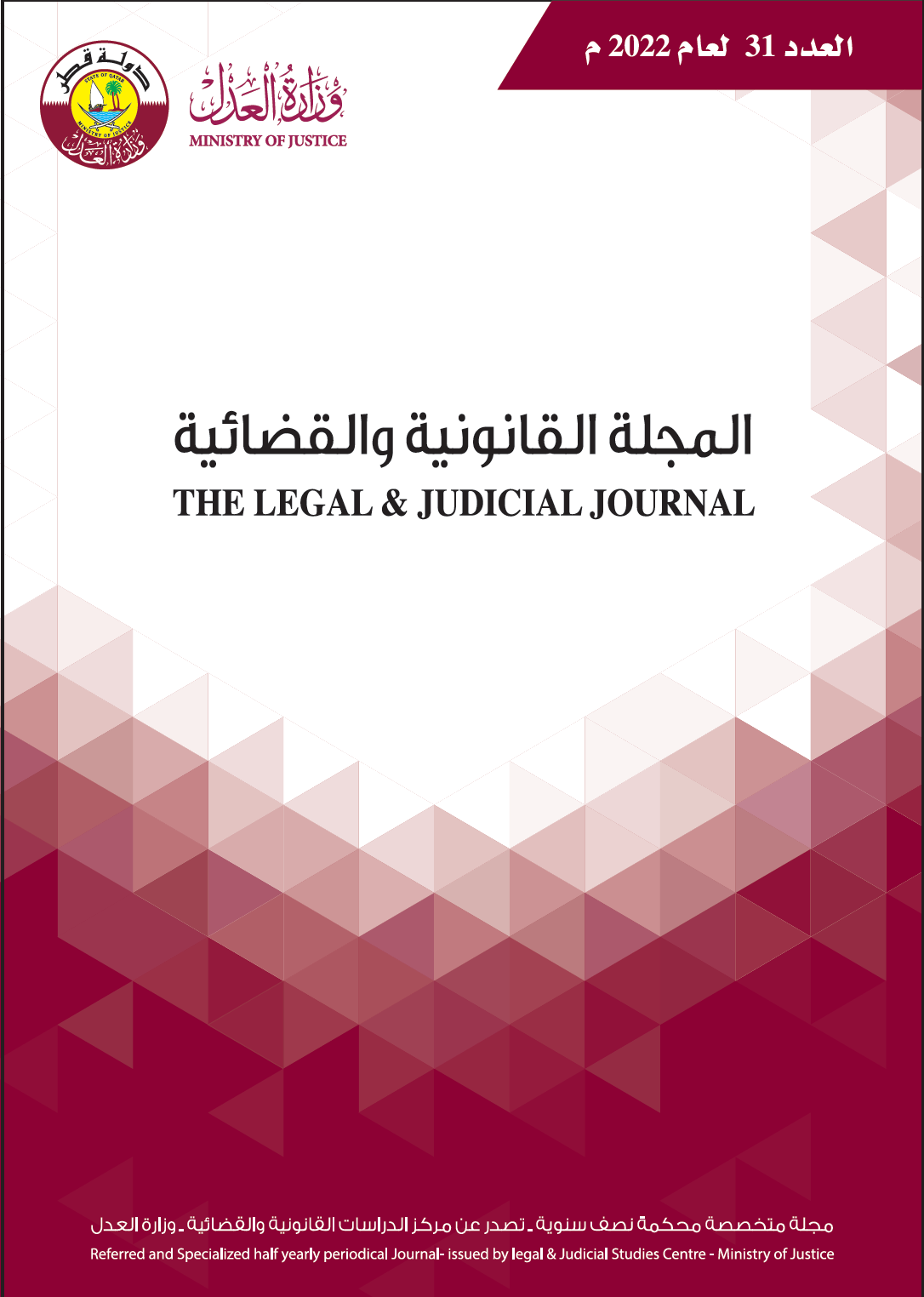
The Legal & Judicial Journal
Vol. 15 No. 2 (2021)
Editorial
Word of the Issue
Optimism and trust in God are among the important elements in life because they are closely connected to faith. They provide hope and encourage positive expectations for the future.
This issue includes research studies on the Qatari judicial control of the institutional appointment of arbitrators, physical coercion in compulsory execution from a human rights perspective in the Qatari system, the assessment of the Qatari legislator's approach in considering trivial harm as a bar to criminal liability, legal rules governing medical replacement in Qatari and comparative law, utility models and the need for their protection in Qatar, and the use of a complainant's sexual history in sexual offence trials.
The issue also contains legislative commentaries, selected judgments of the Court of Cassation, and legal opinions extracted from legal opinions issued by the Department of Legal Advice and Legal Studies at the General Secretariat of the Council of Ministers.
Research Articles
The Qatari Judicial Control of the Institutional Appointment of Arbitrator - Analytical and Comparative
The Qatari Arbitration Act No. (2) of 2017 has the advantage of upholding the principle of procedural party autonomy in a manner (Article 3) superior to that of the UNCITRAL Model Law (Article 2(d)). For example, the arbitration institution's decisions regarding the appointment of an arbitrator are "final" and "not subject to appeal" (Article 11/7).
Problems of appointing arbitrators in institutional arbitration fall into two main categories: inability to constitute an arbitral tribunal, or unlawful such constitution due to violation of the agreement of the parties or mandatory law.
Author analyzed relevant statutes and case law, in light of the best practices. He recommends that Qatari Court to declare competence to supervise and review the decisions of arbitration institutions in appointing arbitrators, if the Arbitration is Qatar-seated, regardless of the status of the arbitral institution being "national" or "foreign". This is in lawsuits for the appointment of arbitrators, setting-aside and exequatur procedures. The author advocates the contractual function of the arbitration institution, and therefore denies its decisions "juridical" classification.
The author recommends that Qatari court not to rush nullification of defected and inoperable clauses of institutional arbitration for their defective mechanism in appointing arbitrators. Best practices show judicial prudence and novation in judicial assistance by turning such arbitral clauses into ad hoc type, and sometimes providing advised road map instead of rushing appointments or nullifications. It is true that the arbitral institution should abide by the parties agreement, but courts should allow institutional deviations in case of expedited procedure, permitted by the Arbitral Rules of the Institution, as is the case of the 2017 ICC Arbitration Rules as long as the parties did not chose to opt out.
Assessment of the Qatari Legislator’s Approach in Considering Minor Harm as a Ground Precluding Criminal Liability
The study focus on the assessment of the Qatari legislator's approach as a "minor harm" to prevent the criminal liability in the Penal Code, and the legal problems resulting from this trend, namely, that the criminal liability is related to the moral element of the crime, Criminal liability and when there is prevention to it, it does not rise basically, while in the case of minimal damage, the crime is complete and criminal responsibility exists.
We divided this study in to three chapters, The first is “Contraindications of criminal liability in Qatari law” , while the second chapter was singled out to clarify the provisions of "negligent harm" as a denial of criminal responsibility. while the third was a place to discuss the problems resulting from the direction of the Qatari legislator to consider the harmlessness prevention of criminal liability, concluding the research anumber of recommendations we belong to the law of the country to take them.
Legal Rules Governing Medical Substitution in Qatari Law and Comparative Law
The doctor performs a humanitarian role; which is to help patients and provide humanitarian services that lead to recuperation following accurate diagnosis and then appropriate treatment. This profession is characterized by being a profession of personal consideration. On the one hand, the personality of the doctors is deemed a consideration for the patient. On the other hand, the pressure that the doctor endures because of the large number of patients, appointments and urgent cases sometimes force him to refer one or more patients to another doctor. This in itself, raises a question about the possibility of referring the patient to another doctor, and calls into question the extent to which this referral affects the responsibility of the original doctor.
The significance of research stems from its close correlation with the interests of society, as every one of us is exposed to disease, and every one of us needs to see a doctor as well as practical reality is full of doctors who do refer their patients to other doctors. Therefore, patients’ referral requires further research to find out the extent of its permissibility and to determine liability in the event of a medical injury. In addition, the lack of research on the subject of medical referrals magnifies the importance of this research. These reasons altogether have prompted the researcher to study comparative laws to find out their practices and applications.
The research reached a number of key results, most notably that the contract between the doctor and the patient is a basis for considering any medical referrals as a sub-contract. In addition, the end of the original contract results in the termination of the sub-contract, as the reason for the existence of the sub-contract is the implementation of the commitment of the original contract. Moreover, the permissibility of medical referral depends or not on the personal consideration in the contract, what matters is the doctor’s personality and its importance to the patient, since personal consideration prevents any person other than the original doctor from carrying out the task. The study also concluded that the original doctor is not responsible for the mistakes of the alternative doctor who replaced him, because he practices his work independently from his colleagues, unless the original doctor exercises effective control over the work of the alternative doctor.
Finally, the study recommended compelling physicians to obtain consent from the patients before referring them to alternative doctors to complete treatment. The consent of the patient is essential so that the original doctor would not be held accountable for the errors of the alternative doctor.
The Use of a Complainant’s Sexual History in Sexual Offences' Trials
This research examines section 41 of the Youth Justice and Criminal Evidence Act 1999. This section regulates the use of a complainant's sexual history in trials for sexual offences, and aims to ‘curb the use’ of sexual history and sexual character evidence in rape trials. Section 41 was undoubtedly designed to effect significant changes to the law of evidential admissibility of a complainant's sexual past, where a sexual offence is charged. It is a significant development and radical reform in the law of evidence and treatment of sexual offence victims in the criminal justice system. However, this section proved to be of limited success. In the wake of the English case law dealing with this issue, complainants can expect very little protection from questioning about prior sexual experience with an accused when the defence of consent is raised. The remarkable effect of the English case law is to require a radical reconsideration of section 41, and changes to the legislation should be made.
Utility Models The Need for Protection in Qatar
With the aim to encourage innovation and create a knowledge-based economy, the Qatari legislative is considering introducing a mechanism in line with which utility models shall be protected. Inventions can be protected by patents law but the requirements of this law must be satisfied, namely novelty, inventive step (non-obviousness) and industrial applicability. An innovation can be regarded as an obvious improvement over the existing art but it cannot be a subject for a patent application since it lacks the requirement of an inventive step. The aim of this paper is to provide the Qatari legislative with a utility models system that can be adopted in Qatar.
The Physical Coercion in Compulsory Execution from a Human Rights Perspective in the Qatari System (A Comparative Analytical Study)
Certainly, the imprisonment for payment of debt for compulsory execution affects human freedom in the light of the great deal of human rights in the international community.
The debtor of civil and commercial debts has rights that must be observed during compulsory execution. An imprisonment for payment of debt for compulsory should not touch the debtor dignity and treated as a slave as it was in the Middle Ages.
It is noted that the concept of the imprisonment for payment of civil and commercial debt as a mean of compulsory execution differs from its perspective in the criminal field in terms of its objectives, where the imprisonment in the criminal field is a personal punishment for crimes committed by individuals and aims to reform more than it aims at force a debtor to pay his civil or commercial debts.
The Qatari legislator has regulated the Imprisonment for Payment of Debt as a mean of compulsory execution related to civil and commercial matters under the statutory provisions (514-518) of the Qatari Civil and Commercial Procedure Law No. 13 of 1990. Article (514) of the Law mentioned above provides: "If the judgment debtor abstains from the execution of final judgment issued against him, the judgment creditor may request the imprisonment of the judgment debtor. The request that summonses the judgment debtor to appear before the competent judge of execution shall follow the normal procedures for filing the lawsuit."
Consequently, this paper examines the imprisonment for payment of civil and commercial debt as a mean of compulsory execution from human rights perspective. The paper is divided into three sections as follows: The first is an introductory section discusses the concept of the imprisonment for payment of debt. The second examines the statutory provisions govern the imprisonment for payment of debt under Qatari Law and others comparative laws. The third and final section analysis the imprisonment for payment of debt from human rights perspective.
The Time Framework of the Public–Private Partnership Contract
تبحث الدراسة الإطار الزمني لعقود الشراكة بين القطاعين العام والخاص، مع تحليل المادة (18) من القانون القطري رقم 12 لسنة 2020، ومقارنتها بالتشريعات الكويتية والإماراتية والسورية والمصرية والمغربية. كما تتناول الدراسة مدة عقد الشراكة، والاستثناءات الواردة عليها، وأسباب تمديد العقد، والسلطة المختصة بالموافقة على التمديد، وتنتهي بعدد من النتائج والتوصيات لتطوير التشريع القطري.
Legislation Comments
Interest in Bringing a Lawsuit in Light of Article (1) of Law No. (13) of 1990 Promulgating the Civil and Commercial Procedures Law
تتناول الدراسة شرط المصلحة في رفع الدعوى باعتباره أساسًا لقبولها وفقًا للمادة (1) من قانون المرافعات المدنية والتجارية القطري رقم (13) لسنة 1990. وتبحث مفهوم المصلحة وأساسها القانوني وأوصافها، وآثار تخلفها على قبول الدعوى، مع تحليل التطبيقات القضائية لمحكمة التمييز القطرية ومقارنتها بالتشريعات العربية والأجنبية. كما تستعرض الدراسة صور المصلحة المحتملة وبعض التطورات المقارنة، مثل الدعاوى الجماعية والدعوى الاستفهامية، وتنتهي باقتراحات تشريعية تهدف إلى تعزيز كفاءة العدالة وحماية حقوق المتقاضين.
- Word of the Issue
- The Qatari Judicial Control of the Institutional Appointment of Arbitrator -...
- Assessment of the Qatari Legislator’s Approach in Considering Minor Harm as a...
- Legal Rules Governing Medical Substitution in Qatari Law and Comparative Law
- The Use of a Complainant’s Sexual History in Sexual Offences' Trials
Register to receive table of contents email alerts as new issues are published.
Register for Alerts