
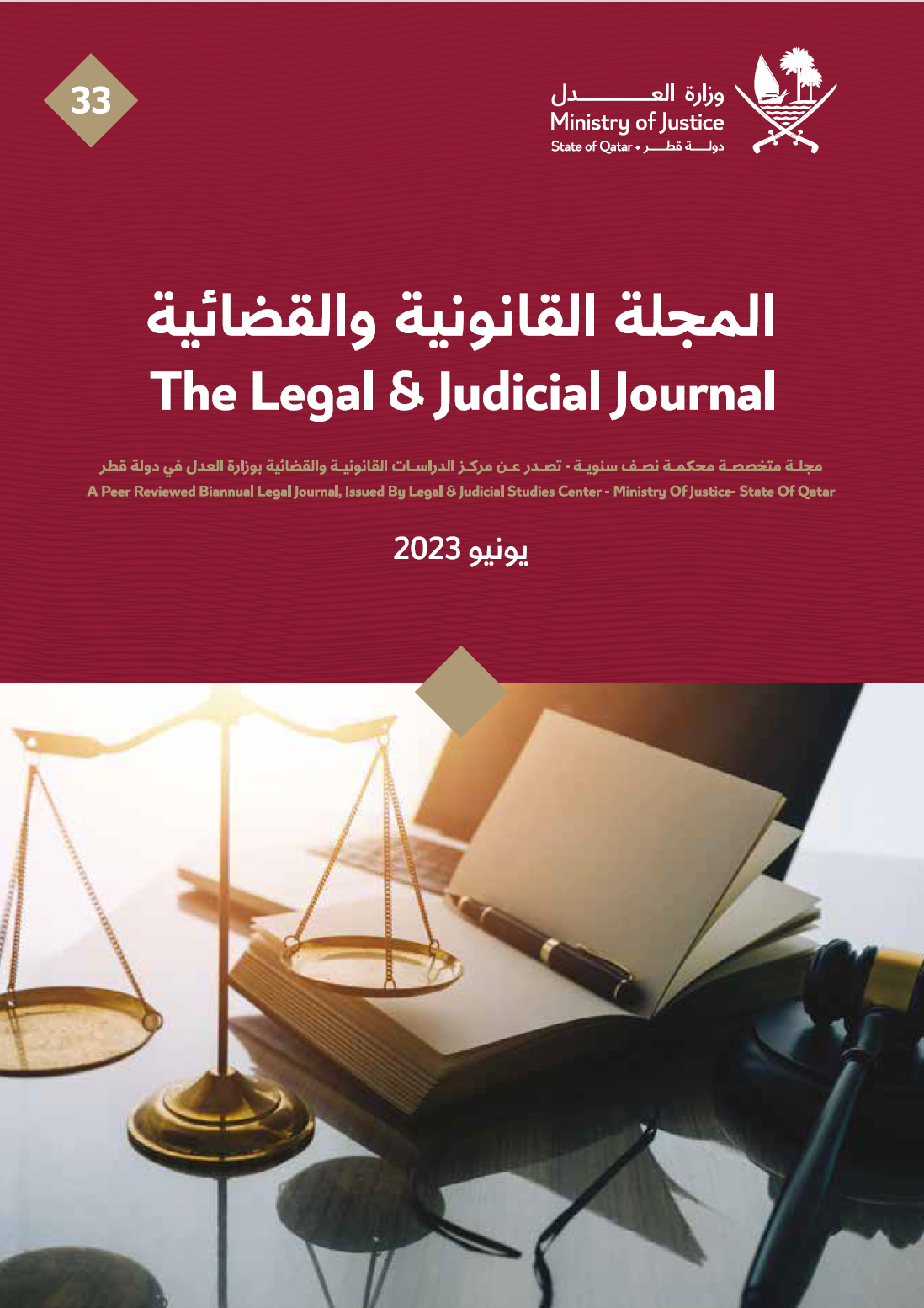
The Legal & Judicial Journal
Vol. 17 No. 1 (2023)
Editorial
Editorial Note / Issue Introduction
This issue of The Legal & Judicial Journal highlights the importance of legal research in the State of Qatar in line with Qatar National Vision 2030.
It emphasizes strengthening scientific research, improving legal scholarship, and linking legal publications with current legal developments at national, regional, and international levels.
The issue includes research articles on international law, investment and trade courts, economic activity, legislative commentary on judicial reconciliation, court judgments in civil and criminal matters, and legal opinions on administrative and public sector issues.
Research Articles
Legal Framework for Protection and Exploitation of Marine Resources extending beyond National Jurisdiction
Open seas and oceans in the areas extending beyond national jurisdiction provide enormous sources of living and non-living marine resources. States have overexploited these areas as being out of jurisdiction or authority of any other state or entity. Consequently, the international community decided in the verge of adopting the United Nations Convention on the Law of the Sea in 1982 to set the general frame for the protection and exploitation of areas beyond national jurisdiction. This was apparent in the form of endorsing the principle of common heritage of mankind, the principle of fair and equitable sharing of benefits from the high seas, and the principle of international cooperation in the conservation and management of marine resources in areas beyond national jurisdiction.
Due to the insufficiency of the practical legal protection established by the law of the sea convention, an additional rules, measures, and guidelines were adopted in subsequent international treaties and through the practices of the competent international organizations, that stressed on the application of universally accepted environmental principles since Rio Declaration of 1992, i.e., the principles of rational and sustainable use of natural resources, environmental impact assessment, and biological diversity, as well as ensuring compliance with protection and exploitation standards in areas beyond national jurisdiction, including the adoption of marine protected areas and particularly sensitive areas.
Finally, the international community concluded that it is pivotal to adopt a global international agreement with unified binding rules that deal with this issue.
Problems Arising from the Scope of Jurisdiction of the Investment and Trade Court: A Comparative Analytical Study
The establishment of a specialized judiciary in matters of investment and trade contributes to finding judicial constants in cases related to these matters, by creating specialized courts in commercial matters of a special nature. It is important to know whether this characteristic will be only through its specialization in specific cases, or it will also be in its formation and its position within the Qatari judicial system. This is given that the qualitative and jurisdictional jurisdiction of this court may conflict with the jurisdictions of other courts that exist and operate within the Qatari judicial system. These are the most prominent problems that this research aims to address, through analysis and comparison.
Partnership as a Means of Practicing Economic Activity A Study in English and American Law
This research deals with the system of Partnership adopted by Anglo-Saxon laws, specifically English and American law, as a means of practicing economic activity. The study explains the basic provisions governing partnerships, including their establishment, management, dissolution, and the legal status of partners. It also identifies the main characteristics of partnerships, distinguishes them from companies, and examines the position of Arab laws regarding this legal system.
Court of Cassation Decisions
Judicial Settlement in Light of Article 66 of Law No. 13 of 1990 Issuing the Civil and Commercial Procedures Law
حرصت دساتير دول العالم على صون حقوق مواطنيها، وتنظيم عمل السلطات الضامنة لهذه الحقوق، والممثلة بالقوانين والأنظمة والمراسيم التشريعية.
وحيث إن الدستور أسمى من القانون؛ فقد جاءت القوانين الوضعية متماشية مع أحكامه في هذا الخصوص، وقد خص دستور دولة قطر السلطة القضائية بالاستقلالية بمادتيه رقمي (130/ 131) كما كفلت المادة (135) منه حق التقاضي للناس جميعًا؛ سواء أكانوا مواطنين أم وافدين، ومن هنا يمكننا القول إنه من أهم وظائف الدولة إقامة العدل بين الأفراد وإعطاء كل ذي حق حقه، وأن من أهم الحقوق التي تكفلها الدول لأفراد المجتمع هي حقهم في التقاضي، عن طريق إقامة دعوى أمام القضاء، وهي الأداة والوسيلة الحضارية للمطالبة بالحقوق، والدعوى القضائية نظمها المشرع القطري من خلال القانون رقم (13) لسنة 1990م بإصدار قانون المرافعات المدنية والتجارية، ابتداءً من رفع الدعوى وقيدها، وصولًا إلى وضع القواعد والإجراءات لحسن سيرها وانتهاءً بصدور حكم فيها.
وعليه؛ فقد اقتبست من القانون رقم 13 لعام 1990 مادته رقم (66) لأسلط الضوء على موضوع الصلح القضائي الذي يمثل إحدى أهم وظائف المنظومة القضائية في إقامة العدل، من خلال استيثاق الصلح فيما بينهم، وفض النزاع القضائي بيسر وسهولة، فضلًا عن تحقيق سرعة الفصل في المنازعات.
- Editorial Note / Issue Introduction
- Legal Framework for Protection and Exploitation of Marine Resources extending...
- Problems Arising from the Scope of Jurisdiction of the Investment and Trade...
- Partnership as a Means of Practicing Economic Activity A Study in English and...
- Judicial Settlement in Light of Article 66 of Law No. 13 of 1990 Issuing the...
Register to receive table of contents email alerts as new issues are published.
Register for Alerts