
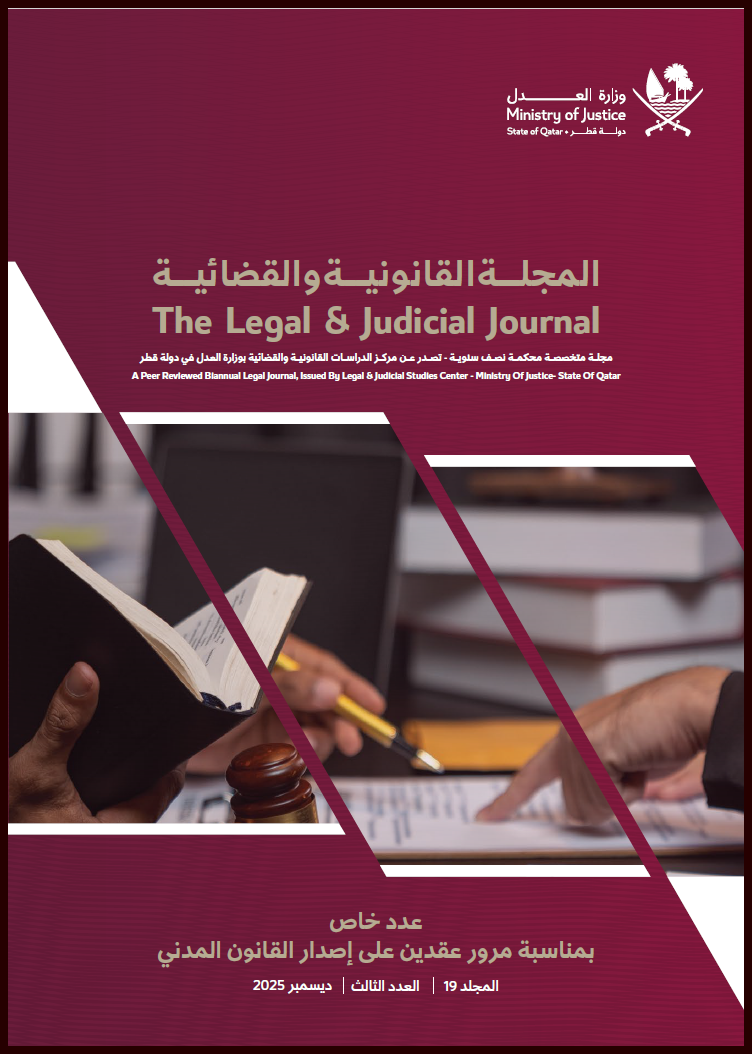
The Legal & Judicial Journal
Vol. 19 No. 3 (2025)
Editorial
Special Issue on the Twentieth Anniversary of the Civil Code
This editorial introduces the special issue of The Legal & Judicial Journal published on the occasion of the twentieth anniversary of the Qatari Civil Code. It highlights the scientific symposium organized by the Legal & Judicial Studies Center entitled “The Civil Code in Its Second Decade: Challenges of Reality and Aspirations for the Future” and presents an overview of the research papers included in this issue.
Research Articles
Towards Developing the Rules Governing the Principle of Good Faith in Contracts under Qatari Civil Law
As the Qatari Civil Code enters its third decade, the need arises to revisit some of its foundational principles in light of contemporary legislative and technological developments. In this context, this paper explores the principle of good faith in contracts under Qatari Civil Law, considering recent legislative developments, comparative legal insights, and the emerging challenges posed by artificial intelligence. It critically examines the adequacy of current legal provisions in addressing the evolving nature of contractual relationships, especially in light of technological and legal transformations (Techno-Legal transformations) and the potential involvement of virtual entities.
Adopting a comparative analytical approach, the study draws on examples from foreign legal systems, notably the French Civil Code, and proposes legislative amendments to reinforce the role of good faith throughout all contractual stages from negotiation to execution.
The paper concludes with recommendations aimed at strengthening good faith as a foundational ethical and legal principle in modern contracting practices. The study concludes with legislative and procedural recommendations, including amending several provisions of the Qatari Civil Code to reinforce the principle of good faith across all contractual stages, particularly negotiation and execution, and to address the legal implications of electronic and AI-driven contracts. It also proposes recognizing the legal personality of virtual entities and incorporating rules on disclosure, confidentiality, and pre-contractual liability. Procedurally, the paper calls for a national initiative to modernize civil legislation, join relevant international conventions, and enhance Qatar’s legislative portal through artificial intelligence (AI)-powered tools.
The relevance of the cause as an essential element of the contract
This research paper is related to the contract theory in Qatari and comparative law, focusing on its most contentious and jurisprudentially debated aspect: the “cause”.
Promoters of the principle of freedom of will argue that the inclusion of “cause” as an element of the contract is erroneous. They claim that:
-
Subjective cause imposes an unjustified constraint on individual freedom, allowing judicial oversight over contracts.
-
Objective cause, seen as synonymous with “subject matter,” becomes redundant once the contractual subject-matter’s conditions are fulfilled.
Despite this criticism, the theory of cause has maintained its relevance. It serves as a vital pillar of contractual justice, enabling judges to restore economic balance in contracts when lacking other legal tools to ensure fairness. This is particularly important given the narrow scope of traditional provisions addressing lesion (disproportionate disadvantage). Article 64 of the Qatari Civil Code reinforces this by stating:
“A contract is formed upon the connection of offer and acceptance, provided its subject matter and cause are legally acceptable...”
Accordingly, this paper investigates whether the inclusion of cause as a pillar of contract in Qatari civil law adds value and effectiveness.
Articles 155 to 157 of the Qatari Civil Code adopt the concept of teleological cause during contract formation. The key question becomes: Does modernizing the legal provisions on cause present an opportunity to make Qatari civil law more effective in contract formation? Or are the existing provisions already sufficient to achieve the intended goals?
To address this legal issue, the researcher uses a combination of:
-
Deductive methodology, starting with related Qatari civil law texts and analyzing their jurisprudential and judicial extensions.
-
Comparative methodology, contrasting the current Qatari provisions with Anglo-Saxon systems and the amended French Civil Code.
Ultimately, the paper starts from the existing practical value of cause in Qatari civil law, to explore its aspired benefits.
Guardianship of property in Qatari civil law in light of technological: Developments
Scientific innovations and research in many fields have led to the production of things with unusual characteristics and complex compositions that have truly and effectively contributed to a radical change in the lifestyle, almost in a gradual manner.
However, they have also included serious threats of causing extremely serious damages, in light of a legislative approach that relies on narrowing the scope of liability for actions. This calls for an interpretive effort on the national legislative data in this field, according to a descriptive and analytical method that relies on comparative experiences. This, on the one hand, establishes the ability of the newly created thing to be protected, despite its immaterial nature and the independence it is characterized by at various stages due to the development of its technologies. On the other hand, it demonstrates the lack of justification for adhering to the condition of the necessity of protection, given its connection to circumstantial reasons for comparative experiences that have no relation to the national reality, and the unfair results it produces that do not take into account the fundamental principles upon which civil liability is based.
Therefore, while awaiting legislative intervention with specific texts to protect those harmed by the risks of these things, it would be better to continue to be guided by comparative creative reasoning to develop the fundamental idea upon which the condition of guarding a thing is based, which is the ability to control the thing to prevent it from harming others, which enables the elements of guarding to be adapted to these developments.
In addition, the international community must expedite the formulation of ethics that regulate the methods of designing, producing, and using modern technological and digital means to direct minds towards using them in a way that is compatible with the quality of life and serving the human self, as long as they are the product of its creative thought, which contributes in an effective way to limiting its theoretical capabilities and preventing the harms that may arise from them with unknown consequences.
The Legal Classification of Waqf Land Investment Contracts
This study examines the legal framework governing contracts for the investment of waqf land under Qatari legislation by analyzing the relationship between the haikr (long-term lease) regime laid down in the Civil Code and the system of waqf development and investment introduced by the Waqf Law. The research departs from a central question: whether the Qatari legislator has preserved the traditional haikr system or moved beyond it toward a new contractual model that better aligns with contemporary requirements for waqf-based development.
The paper demonstrates that the evolution of waqf investment reflects a shift in legislative philosophy—from reliance on traditional, quasi-permanent contractual forms to the adoption of a modern investment approach based on flexibility, institutional oversight, and the sustainable management of endowed assets. It further shows that the Qatari legislator has reformulated the relationship between the waqf and the investor within a new regulatory framework grounded in administrative supervision and waqf governance, striking a balance between the preservation and the development of endowed property.
The study concludes that Qatari legislation has moved toward renewing the concept of waqf development by abandoning traditional systems rooted in haikr and embracing contemporary investment contracts that respect the specific nature of endowed assets and align with their legal, economic, and religious objectives. This shift reflects a clear legislative vision aimed at transforming the waqf into an effective instrument of sustainable development, thereby enhancing its role in supporting the State’s social and economic goals.
- Special Issue on the Twentieth Anniversary of the Civil Code
- Towards Developing the Rules Governing the Principle of Good Faith in...
- The relevance of the cause as an essential element of the contract
- Guardianship of property in Qatari civil law in light of technological:...
- The Legal Classification of Waqf Land Investment Contracts
Register to receive table of contents email alerts as new issues are published.
Register for Alerts